
Adventurer Tim Hewitt recounts his rescue from Topkok
By Peter Loewi
Tim Hewitt’s plane to Anchorage has a flat tire. Despite having been unable to walk there, as he had planned, Hewitt is remarkably upbeat. “I’m sitting here, so I think I have a fair amount of luck,” he said.
According to the story Hewitt told, a member of the Nome Volunteer Fire Department Search and Rescue, said so, too: “You’re the first one I’ve brought in alive. We pull quite a few people of this blowhole. You’re a lucky one.”
Nome Fire Department Chief Jim West Jr. said, “We go through quite a few rescues in that area. That is a known problem area.” He said maybe four to five a year, but “hasn’t been keeping track.” And, yes, “we’ve lost a number of people in that area.”
Hewitt has walked the Iditarod Trail nine times and ridden it once on a fat bike. He holds the course records for the north and south routes, as well as the overall course records for a walker. He has even experienced the blowhole, which, he said, “scared the living crap out of me.”
Hewitt attempted to walk the Iditarod Trail from Nome to Anchorage, but even before he reached Nome, the trip hit some snags. Storms in Pittsburgh, where he lives, delayed his plane, and baggage issues delayed him further. He and his sled “Cookie” arrived in Nome on the evening flight on Saturday, February 5, and at 6:34 p.m., they left on the trail. “I was fighting the wind from the moment I got out of town,” he said.
He spent the night, sleeping around three hours, out of the wind in the quarry behind Cape Nome. As the day broke, he removed his headlight and hood of his parka, storing them in his duffle bag. “I didn’t want to get my parka wet with sweat,” he explained in a blog post several days later.
Finding what he thought to be the safety cabin at Solomon padlocked, he pushed on past Bonanza Bridge, and into the Solomon Blowhole. Thirty-four miles from Nome was “a whiteout that is so defined it is unbelievable. In short, it looks like a white curtain in front of you draped from the sky to the earth,” he wrote. About an hour later, he made it to Tommy Johnson’s cabin. A window was missing, and he was unable to shelter there. His tracks eventually provided info for the Search and Rescue team that would go out looking for him several hours later.
Almost immediately after leaving the cabin, the Topkok Blowhole picked him out, and a “ferocious roaring wind” blew him over. Sliding over the ice towards the sea, he was able to use his trekking poles to stop the slide. “That was the worst point,” he said, “snow was being blown everywhere, I couldn’t really see much.” He could see his sled getting slammed up and down, and he could see his ground pad fly off, but he couldn’t see his duffle.
And that’s because it, too, had been blown out of the sled to sea. “It had my headlight and everything in it, my sleeping bag, my stove. Everything I needed to survive. And the tracker.
His only chance left of survival was to make it to the Topkok Shelter Cabin. He had no light, so he had to be quick, but the wind had blown snow into his goggles. “I made a calculated decision, I knew I was going to get some damage from lifting those goggles up, but it was a matter of trading off time for opportunity. Maybe some skin damage, maybe some frostbite, in order to get to that safety cabin, which I thought was more important,” he explained. “It was pretty intense.”
His Trackleader still showing him on the beach close to a lagoon west of Topkok around 7:30 p.m., the State Troopers were notified of an SOS beacon. Hewitt had activated his Garmin inReach, the only piece of equipment kept on him. Within an hour, four Nome Search and Rescue volunteers left Nome on snow machines, Assistant Chief Kevin Knowlton, who was on duty that night, said.
Hewitt had waited to hit the SOS button, wanting neither to confuse rescuers with two different GPS locations [one from the Trackleaders device, one from the inReach device he had on him], nor risk the lives of rescuers. But, he said “I didn’t know that I’m going to make it to the safety cabin before dark, and if I didn’t, I’m going to be in trouble. I could die out here tonight.”
Friends and family in the Lower 48 saw the SOS, and reached out to friends in Nome. Carol Seppilu and Phil Hofstetter got involved and alerted the Nome Volunteer Fire Department. “I know Phil very well, and Phil said, look, he’s not going to push an SOS button if he isn’t in trouble. They might think he’s still moving, but he’s in trouble, or her would not have hit that SOS button,” Hewitt said.
In the meantime, Hewitt kept walking, looking for the willows that mark the cabin. “On the one hand, I need to stay along that beach line, to find where I’m going, because that’s my point of navigation, and on the other hand I’m scared I’m going to get picked off by the wind again,” he described.
Just as suddenly as the blowhole started, it ended.
In the dark, he walked past the shelter cabin, but realizing the terrain wasn’t right, Hewitt turned around and saw its silhouette.
Once inside, in the dark and with one eye swollen shut from frostbite, he felt around, and in time, was able to find a lighter to get a fire going. Knowing he now won’t die of exposure, he walked outside and tried to deactivate the beacon, expecting a snow machine to pass by in the morning.
About two hours later, however, the four volunteers from Nome smelled the woodsmoke and located Hewitt in the cabin. After warming themselves up, too, they brought Hewitt back to Nome to the Emergency Room.
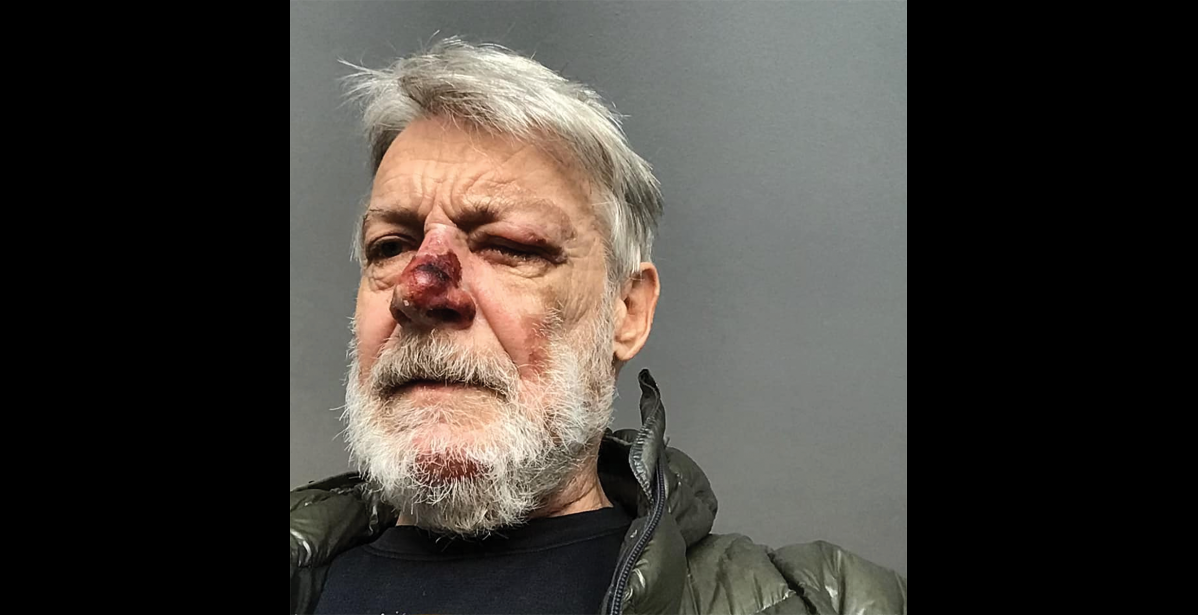
On his blog, Hewitt writes, “I spent the next day in the hospital. The fire and rescue crew was out in full force to welcome me in Nome. They took me straight to the hospital. I had couple IV bags. Lung X-rays, albuteral treatments, frostbite assessments and optometry evils and bloodwork. For now, the left eye still doesn’t open and has significant hemorrhaging inside the eye. It is fighting infection and creating goop that has reduced vision to 20/80; the other eye is better but the vision is also impaired. I will follow up after a week when the swelling reduces. In the meantime I have eye drops and antibiotics. The ER doctor thinks skin grafts may be necessary on my nose because the burn goes through to the subcutaneous level. I have antibiotics for infection there as well.”
“I really don’t know what you can tell people,” said Hewitt. “Surviving one of those is probably more mental than anything else. I really don’t know. My advice would be to stay the hell out of them [blowholes] if there’s any way to do it. You’re risking it big time when you go into it.”
Conditions were so bad that one of the volunteer rescuers had to be treated for frostbite, as well. The Nugget reached out for interview with him, but he had not accepted by press time. SAR Chief Jim West expressed gratitude that the Nome Kennel Club maintains the cabin there, saying it has “proven its weight in gold over the years.” He was also thankful for the GPS technology, encouraging travelers in the region to get such a device.
The devices aren’t cheap. A Garmin inReach like Hewitt was carrying costs around $400 and requires a subscription. The GPS device sends out coordinates that pinpoint the location of the person in need of rescue. Knowing where someone is stranded or injured gets rescuers quicker on scene and greatly decrease the costs for SAR. The Volunteer Fire Department is reimbursed by the Alaska State Troopers for gas and repairs, and in the event of longer searches, food, as well. They also have a workers’ compensation policy with the City which covers medical expenses; the injured volunteer, says West, missed a day of work.
During Monday’s Common Council meeting, Councilman Mark Johnson acknowledged the heroic effort by Nome SAR volunteers Dale Ellanna, Brandon Tran, Chase Gray and Casey Sherman to rescue Hewitt.
SAR Assistant Chief Knowlton recommended to be prepared and gather information on weather conditions. “The big thing is not just check the weather where you’re at, but anywhere along your route,” he said. “Take advantage of weather stations and things like that. Also, make sure you file a travel plan so that if they do run into problems and don’t have a GPS locator like Tim had. Really make sure that people know where they’re going and when to expect them so if they are overdue we can come help them if we need to.”