
Local youth clean up Nome’s beaches
Kids cleaning up trash on Middle Beach on July 31 ended up finding a whole host of strange pieces of trash. Old ropes, tires, a pig's foot and a discarded strobe beacon were some of the debris collected by Nome Eskimo Community's Outdoors Club, helped by Kawerak Environmental and Gay Sheffield with UAF Alaska Sea Grant.
The Norton Sound Health Corporation’s Environmental team donated gloves, Nome Police Department donated yellow trash bags and Public Works donated trash grabbers. The group ended up cleaning up over 30 bags of trash in just a few hours of work.
NEC’s Outdoor Club focuses on getting kids in Nome outdoors and connected with culture and community. Angie Nguyen, Outdoor Club's coordinator, explained that NEC asked UAF Sea Grant Map Agent Gay Sheffield to lead an activity with the Outdoor Club.
Sheffield suggested cleaning up Middle Beach. She brought an educational aide to show the kids why trash cleanup was important – a flyer. On one side were pictures of trash found on beaches surrounding Nome, and on the other was a photo of a murre that had died after eating trash. Sheffield explained, “Let's do our part. We're all down there to clean the beach."
Sheffield found the murre dead on a gloomy July day with a piece of trash blocking its cloaca. “It's extremely emaciated,” Sheffield said, pointing to a photo of the bird lying in the sand. “You could feel its keel right here, which would be covered in fat, and it was like a knife blade. This had no fat on it left, so it had starved to death.”
“This must have been extremely uncomfortable for lots of reasons, and then also not to be able to pass any food for days,” said Sheffield. “Sea birds have high metabolism, so it doesn't take long if you have a problem to start starving.”
Ali Smithhisler, one of the kids helping clean up the beach, described what happened to the bird and the trash it consumed. “It like ate it, and it couldn't digest it, so it died. And when they got to the lab, they took [the trash] out," she said. "They took a picture of it and showed us. It's like a plastic thing.”
Sheffield and Ayla Knodel, a Community Engaged Fellow with Alaska Sea Grant, found the bird while looking for washed up marine debris – plastics, ropes and other trash – on July 22 about seven miles up on West Beach. When Sheffield finds a dead bird, she checks it out to see the cause of death. “You go look at it because it could be avian flu,” she said. “We're going to document the dead birds, and if it's intact and fresh, we're probably going to put it in the queue in the freezer for later avian influenza testing.”
“Each animal has a story. When you see birds that are in poor body condition, that's a clue that something's really wrong," she said. "Either they are not able to eat, meaning they don't feel good, or they're throwing up, or in the case of this murre, they couldn't pass anything.”
Seeing the bird helped the kids understand the importance of cleaning up the beach. "They were quite interested, and they found it gross because they saw the picture and they were like, 'Ew,'" said Nguyen.
When the group got to Middle Beach on July 31, they found the beach covered in trash – tires, dirty diapers, metal, plastic, ropes sticking out of the sand.
Middle Beach is a snow dump for the city. Snow collected from all over town gets pushed to the area during winter. “The ice melts and the trash stays,” said Nguyen.
Joshua Contreras and Granite Peacock, interns with Nome Eskimo Community who helped with the Outdoors Club, said that Middle Beach used to be much cleaner. It was Peacock’s favorite beach. Around five years ago, when the city started dumping snow there, the beach got noticeably dirtier. “But it's really not their fault. It's our fault because that's our trash. It's our stuff that we eat, drink, everything like that,” said Contraras.
City Manager Lee Smith said that snow isn't pushed down onto the beach and plows stop moving snow at the rocks. When snow melted down this spring, the city went out and cleaned up debris that emerged. But people toss stuff out on the beach anyways. “People will throw tires out,” said Smith.
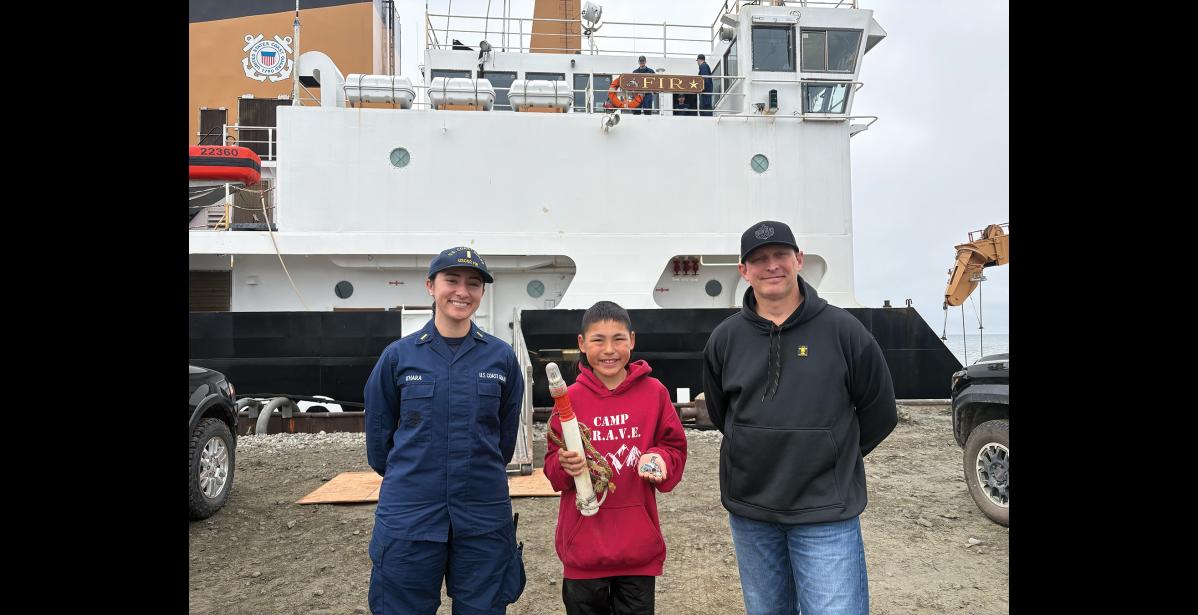
Adrian White was one of the kids cleaning up the beach, along with Smithhisler and Theo Sparks. White was poking around the rocks when he found a strobe beacon sticking up out of the ground. He held out his hands a few feet apart to demonstrate how big it was. “Probably went on the sand, and when it was done, it got buried on the sand and buried up straight," he said.
The beacon had a rope attached and was still flashing. Sheffield took White over to U.S. Coast Guard Buoy Tender Fir, which happened to be docked at the port. There, the crew looked at the beacon and gave White a special prize – a challenge coin. Challenge coins are unique symbols of different units within the U.S. military and are occasionally given to civilians in recognition of gratitude.
The crew onboard the Fir looked over the beacon and gave it back to White. “They told us it was modified, so it would not have been for use with the U.S. commercial fisheries,” said Sheffield.
The cleanup effort was a success. The Outdoors Club collected a whole flatbed truck's worth of trash. Smithhisler said it’s important to clean up trash because it helps the animals. “Even the little pieces and bits of trash that a bird could swallow up like the bird that we saw," she said.
The kids saw the impact they made in just a few hours. "Afterwards they were like, 'Yeah, we would play in this,'" said Nguyen.
What did the kids learn from cleaning up the trash? "It's a good thing to do," they chorus in unison.