
Mary Peltola and Bill Hill are lone participants at AFN candidate forums for Senate and House races
At the Alaska Federation of Natives convention in Anchorage last week, all three members of Alaska’s congressional delegation spoke at the convention on Thursday, October 22. But Senator Dan Sullivan and Representative Nick Begich were a no-show at the candidate forums.
Congressional reports
Senator Lisa Murkowski spoke in a half hour slot Thursday morning to a full crowd. In the afternoon, Senator Dan Sullivan and Rep. Nick Begich were scheduled for 20-minute slots, although Sullivan spoke for over 40 minutes.
Sullivan had nearly as full a crowd as Murkowski, but the crowd thinned out when Begich stepped up to the podium.
Sullivan was introduced by Megan Onders and Sheri Buretta. Onders is the King Island Native Community Tribal Chief and spoke on the ARTIST Act, which prevents states from banning Alaska Native artwork made from marine mammal ivory, bone or baleen. Sullivan sponsored the act.
Sullivan spoke about his desire to re-open National Guard armories in rural Alaska, calling their closure a “gut punch” to the state. He touted military investments in Alaska and talked about the porting of four icebreakers in the state. “Think about that. It took our country 250 years to figure out that you should put the icebreakers in the state with the ice,” he said.
He pointed out that President Trump had signed Sullivan’s North Pacific Research Board Enhancement Act, which adds an additional member to the board to represent Alaska Natives.
Sullivan stayed away from mentioning President Trump by name in his speech, despite the president and vice-president having come to Alaska in support of him.
He reaffirmed his desire to build the natural gas pipeline. “Don’t listen to the naysayers. They’ve never built a thing,” he said. “We’ve never been further along on this project. The federal government is now in the lead. We’re going to get it done.”
Begich started his speech by referencing the one-year anniversary of Typhoon Halong’s destruction, saying that the determination of those who had dealt with the storm were inspiring. “My commitment is to continue working with your communities and our state and federal partners to support the recovery and help families continue to build a stronger future for themselves,” he said.
Begich also brought up the Alaska Native Settlement Trust Eligibility Act, which he championed and which excludes trust payments from being factored into whether an individual qualifies for some needs-based programs such as SNAP. Begich, like Sullivan, also brought up the ARTIST act.
He closed his speech by saying that he had come to AFN one year ago and made promises to listen and work with those gathered there and had come back now with results. “Tomorrow, we’re going to get back to it because there are still commitments to fulfill, still opportunities to create, and still a future worth building,” he said.
Begich and Sullivan missing in candidate forums
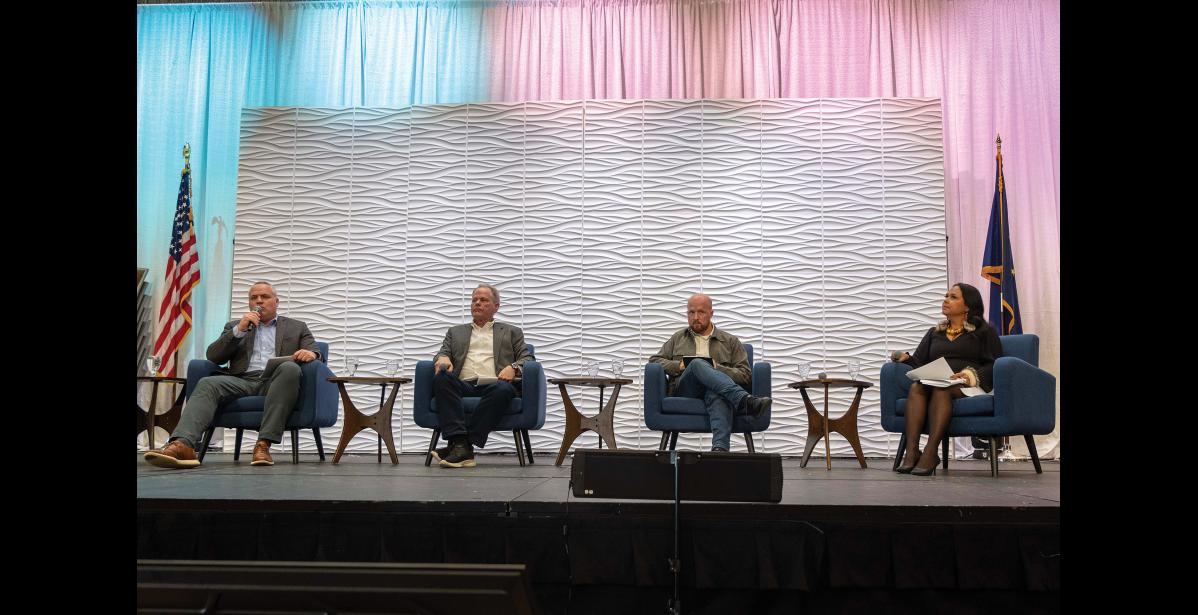
On Friday, candidates for governor and some for Congress and the Senate participated in the much-anticipated candidates forum. Neither incumbent Republican Senator Dan S. Sullivan nor incumbent Republican Rep. Nick Begich showed up, leaving their opponents, Democrat Mary Peltola and Independent Bill Hill, jilted onstage. In the gubernatorial forum, Republicans Treg Taylor, Dave Bronson and Democrat Jonathan Kreiss-Tomkins showed up; Republican Bernadette Wilson did not.
Gubernatorial forum
The candidate forum was not a debate; rather, candidates each had a set amount of time to answer question, moderated by journalist Antonia Gonzales. Kreiss-Tomkins by far generated the most applause, especially when he affirmed that he would support subsistence and would not pursue litigation. “I will protect and uphold subsistence as the state’s most important priority and use of resources, and that includes protecting rural preference as exists and as promised under ANILCA,” he said.
All three candidates offered up solutions for Alaska’s housing crisis. Bronson suggested utilizing the University land trust; Taylor suggested federal and state offices in rural areas build joint housing in excess and Kreiss-Tomkins suggested partnerships with tribal governments or housing authorities. All three affirmed their desire to work on public safety and Missing and Murdered Indigenous Persons. All three candidates spoke in favor of forward funding education.
By the time the gubernatorial candidates finished, Bill Hill and then Mary Peltola took the stage. The crowd, although enthusiastic, was much thinned.
A one-man show
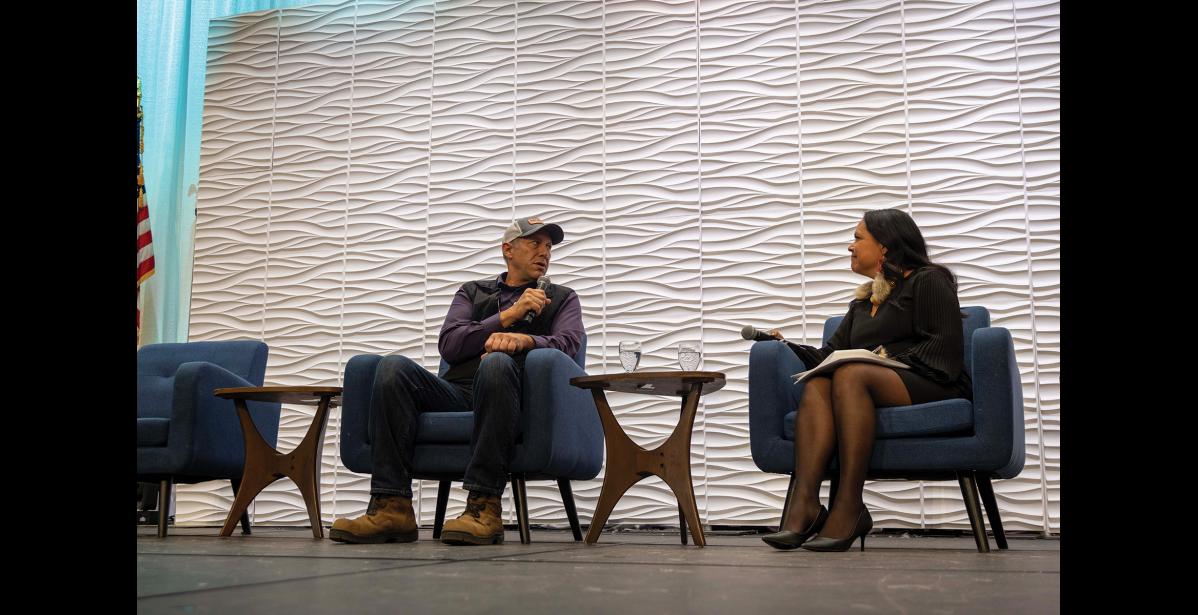
Independent Bill Hill joked with Gonzales: “What do you call a forum with just one candidate?” before launching into about a half hour question-and-answer session. Hill, Dena’ina Athabascan from Bristol Bay, reaffirmed his support for subsistence, for tribal voices on the federal subsistence board and for co-management of hunting and fishing resources. “We need to make sure that we have some things like tribal representation on the North Pacific Marine Fisheries Council, those are the kind of things I work for,” he said. “Those are the things we need, and we are the best people to be making the decisions that affect us every day.
He spoke about the importance of supporting the VPSO programs and said he would vote to reauthorize the Violence Against Women Act. “Let’s make sure we communicate with the people who are affected first, because that’s the right way to write legislation: is to ensure that our voice is heard before it’s passed,” he said.
Hill acknowledged that Alaska holds an important place in Arctic security. “We are the only state in the nation that represent our Arctic stance, and we need to make sure that we have really secure housing, water, sewage systems,” he said. “A strong Bush Alaska means that our Arctic nation is not vulnerable to attacks.”
Hill committed to returning to AFN and said he would be a voice for all Alaskans, including working Alaskans, Native Alaskans and those living in the Bush. He said what he needed from constituents was for them to communicate with him. “At the end of the day, if I am not doing my job in Congress, the next time there is an election, I want you to vote me out,” he said.
One-woman Senate forum
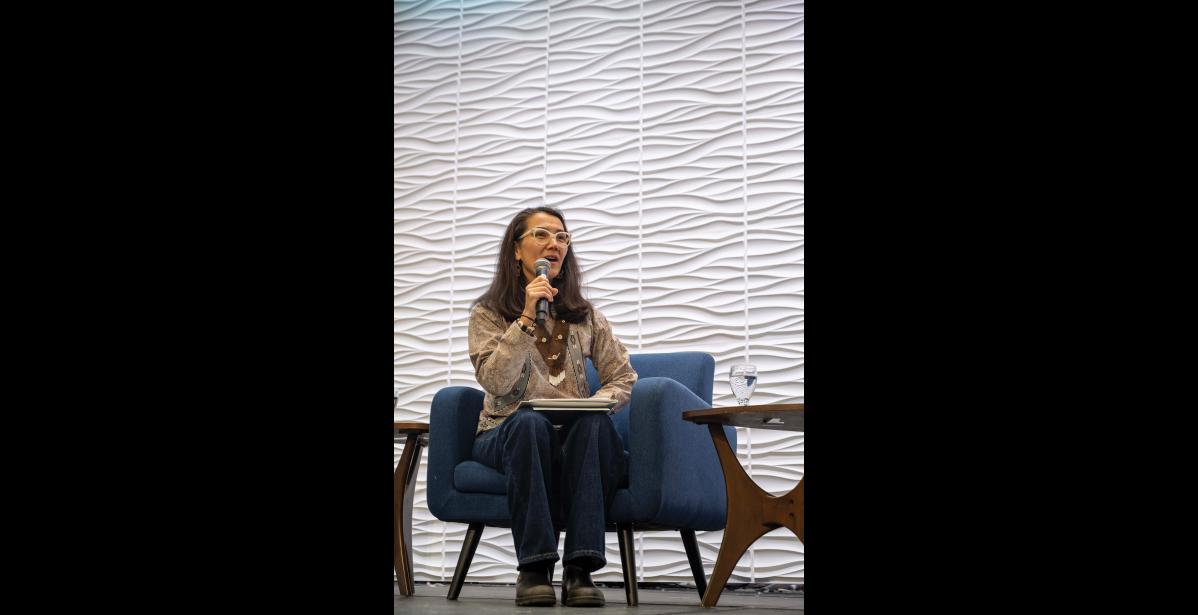
Mary Peltola was asked what protecting Alaska Native ways looked like to her and she answered that subsistence is not a adequate term. “Subsistence implies bare minimum, in my opinion, and being able to hunt off the land and live off the land and teach our children our values through hunting and fishing. That to me is the maximum quality of life,” she said. “That is the maximum holistic way of living, connected spiritually, connected physically.”
Peltola reiterated many of the talking points from her campaign. She reaffirmed her commitment to Alaska Native voices having a seat at the table when discussing hunting and fishing rights, as well as co-management systems. She talked about the importance of a strong national guard presence in Alaska, particularly in the case of relief and rescue from storms.
In response to a question on the rising cost of energy, Peltola said that Alaska has “unlimited renewable energy potential” and that no one should have to choose between their groceries and their heating bill. She said the Low-Income Home Energy Assistance Program should be modernized and expanded. She also said she was not discounting non-renewable energies. “We know that we will always need gas and oil,” she said. “For the regions who want gas and oil development, we want to make sure that we’re protecting their right to develop their resources.”
When speaking about MMIP, she teared up. She pointed out that MMIP is a huge issue in Alaska. “Behind every number, there’s a person with a name, and a lot of families are still looking for these people,” she said. “Missing and murdered Indigenous people is a year-round concern, and it is everywhere.”
She also spoke about recent challenges to the Alaska Senate race. A Department of Justice lawsuit seeks to prevent Alaska from certifying the election results if incumbent Senator Dan S. Sullivan loses narrowly, with an investigation to determine if voters were confused by the inclusion of retired teacher Dan J. Sullivan of Petersburg on the ballot. “This is just flagrant, flagrant corruption, in my opinion,” she said to a smattering of applause. “This is a sad, sad attempt.”