
Repurposing and reusing the theme of Nome Garden Tour
A bright yellow school bus idled in the Old St. Joe’s parking lot as a crowd of thirty or so eager Nomeites gathered for one of the beloved events in Nome’s summer season – the Nome Garden Tour. But instead of a Sunday, the 2026 Nome Garden Tour began around 5:30 p.m. on Wednesday, August 19. The weather cooperated as it was sunny and a little breezy.
The tour started with a quick jaunt across Anvil City Square to Nome’s Community Garden, on the corner of Seppala and Bering Street next to the Nome Food Bank. People meandered through the raised beds growing kale, peas, cabbage, rhubarb, potatoes and broccoli. Bumblebees rested in some flowers. One bed of yellow flowers sparked a debate over what kind of plant it was. Lisa Leeper tasted a leaf and said, “It’s not arugula,” before reconsidering. “It could be really tough arugula.”
The next stop was just a few blocks away at Sew Far North, where shop owner Sarah Savage gave a tour of her small greenhouse and showed off her glorious rhubarb plant. “I have moved this rhubarb plant so many times,” she said. “Last year I had to move it from one house and it stayed in a bucket for two years, and I planted it a couple months ago, and grew and blew up and got a lot bigger.”
Next, people piled onto the school bus and driver Mariah Morgan took the crew up the Nome-Teller Highway to Kim Knudsen’s house near the Dredge No. 7 Inn. As the bus pulled onto the road, Angela Hansen passed out pastries and candy to keep people fueled for the arduous task of viewing flowers.
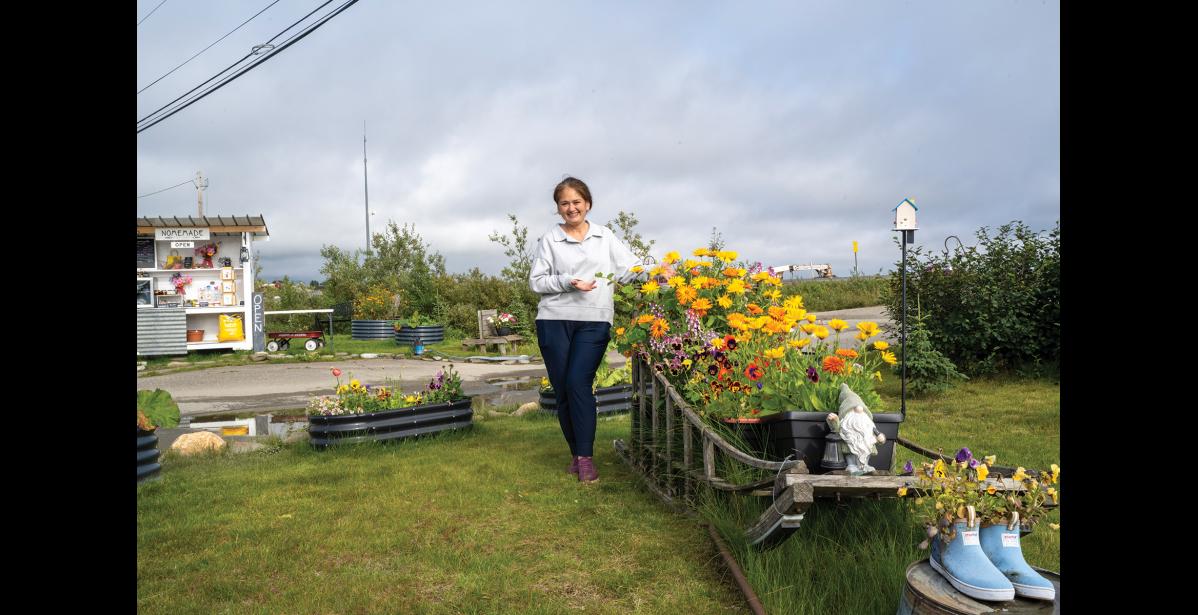
At Knudsen’s house, a giant dredge bucket filled with colorful blooms flanked her driveway. Trees transplanted from her camp framed open green spaces. Knudsen issued a challenge to the kids of the group – tell her how many gnomes and how many chickens resided on the property and receive a prize. (A Nome Nugget inquiry later revealed the true count: nine gnomes, 15 chickens.)
The centerpiece of Knudsen’s lawn was a large sled filled with flowers. Cast off Xtratuff deck boots served as impromptu flower buckets. In her greenhouse, cucumbers – self-pollinating – lined the sides. Outside, a riot of blooms added to the frenzy. Was this her best ever year? “Probably,” she said.
Knudsen’s advice is simple – she learned from earlier garden tours and built up her garden over years of work. Don’t be afraid to use unconventional containers to house your plants. “I use totes,” she confessed. “I use the luggage, the totes that we use for our Costco shopping, and drill holes on the bottom of it, and then I plant potatoes in them.”
Next, the bus headed north to Angie Gorn’s place in Icy View. A big lawn bordered by tall trees created a hollow from the tundra landscape. The back path out of the yard was barred by a pipe about a foot off the ground – a musk ox deterrent. Gorn said that the creatures come every year like clockwork and clear her out. On one side of the yard, raspberry bushes had taken over a greenhouse. Of gardening, Gorn said it’s therapeutic. “I love landscaping. I love mowing the lawn. I love playing in the dirt,” she said, laughing.
Gorn and Nancy Bahnke had been hard at work, grilling up food – including a whopping 65 bratwursts – and setting out treats. Others contributed baked goods and other dishes. People wasted no time digging in. Touring gardens is hungry work.
The next house was just a short jaunt up the street – Angela Hansen’s. A puppy tied up on the front lawn welcomed guests with kisses. The lawn was grassy and full, and beds filled greenery and flowers framed the front of the house, but it was the back garden that was the real star. Following Hansen across her cheery blue deck into the backyard, people descended into something akin to a secret garden. Tall alders formed green tunnels around the space, hiding treasures. Descending down the stairs into the yard felt like stepping into another world. Colorful blooms stood tall, and the shade was broken up by bright beams of evening sunlight.
Among the trees were other treasures – a picnic table, a swinging bench seat, a toilet repurposed as a flowerpot. Hansen offered up free plants, and many participants came away with one.
From Hansen’s, the tour headed to what was described as “the best lawn in town” – Julie Kelso’s place. Kelso had a big greenhouse filled with light. She warned visitors to not touch plants, as she’s been dealing with an aphid infestation, which sparked a debate on the best way to deal with aphids and other pests.
Kelso built her greenhouse with a grant from U.S.D.A., and this is her first year with it. “I made lots of mistakes, and you’ll see that in my greenhouse I didn’t really allocate the space correctly,” she said. Some things are really sparse, she said, some things are over planted.
As participants started to leave for the next stop of the tour, there was much discussion about how to back the bus out of Kelso’s driveway and onto the Nome-Teller Highway. With spotters at the back of the bus keeping an eye, driver Mariah Morgan successfully maneuvered the behemoth out and was met with cheers from the passengers.
The second to last stop was Lisa Leeper’s house, high up the Dexter Bypass Road on the slopes of Newton Peak. The breeze had turned chilly, but that didn’t stop people from poking through Leeper’s numerous greenhouses and checking out her plants. Her advice? Just like Knudsen, she advises repurposing cast-off building materials. “A lot of this stuff just comes from the dump,” said Leeper, gesturing to her greenhouses, built by her husband. “We didn’t buy a lot of new wood, per se, or things. He just repurposed stuff that we found.”
Leeper said she gardens “haphazardly”, but the results speak for themselves. Strawberries, kale, broccoli, rhubarb and even colorful purple potatoes all make a home on her property. Why purple potatoes? “Just because I think they’re pretty, and I like to eat really pretty potatoes,” she said.
The final stop of the tour was Nome-Beltz High School’s student garden. One greenhouse was attached to the school, and others were scattered across the landscape nearby. Cheryl Thompson, Nome’s Master Gardener, has taught a gardening class for years, and many in town turn to her for plant advice. Inside the school’s greenhouses, plants and gardening tools filled narrow benches. In one, some wilted leaves showed the evidence of too-hot temperatures. Another held oodles of sweet peas, fresh and crisp off the vine.
Near one outer greenhouse, barriers made of pallet wood surrounded a compost heap. Thompson said the class gets people out of their shells. “It’s super therapeutic to have your hands in the dirt,” she said.
Around 10 p.m., the fun wound to an end and the bus carted people back to Old St. Joe’s.
Thompson started the tour years ago, inspired by the beauty people cultivated in their yards. “People need to see they don’t need to live on a gravel pad with a bunch of snow machines,” she said.