
Researchers test harvested birds for avian flu
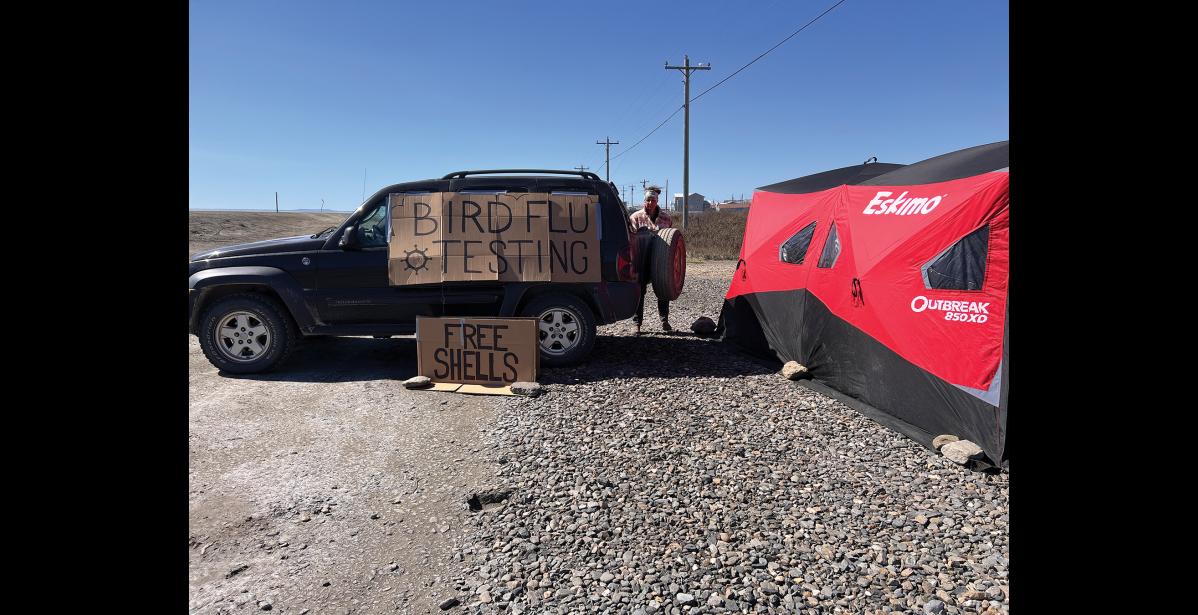
Nomeites are used to odd sights. But huge cardboard signs saying, “Bird Flu Testing” and “Free Shells” propped up against a rental car at East End Park did warrant a double take. Turns out, researchers were in Nome last week, conducting avian flu testing of subsistence hunted birds, inviting hunters to bring by their harvest for a quick swab.
The researchers were Dr. Lisa Kercher, with St. Jude Children’s Research Hospital from Memphis, Tennessee, and U.S. Geological Survey Alaska Science Center Director of the Molecular Ecology Lab Andy Ramey from Anchorage.
The question that Dr. Kercher has to answer often is why is the children’s hospital interested in the avian flu? “St. Jude Children’s Hospital has done avian flu research for 50 years,” said Kercher in an interview with the Nugget. In 1966, Rob Webster with St. Jude figured out that the reservoir for avian flu is waterfowl, establishing how influenza travels as a zoonotic disease from birds to mammals, including humans, she said. The St. Jude Children’s hospital treats catastrophic diseases in children, and if a child is sick with cancer or other serious diseases, getting a respiratory disease can be devastating, hence they do research on respiratory diseases and all kinds of influenza viruses, including the bird flu.
There are different kinds of strains of avian flu. Some are more serious than others and the bird flu of concern is called the Highly Pathogenic Avian Influenza, HPAI for short. Of that, the H5 strain is of special concern.
In a Strait Science presentation, hosted by Northwest Campus and the Alaska Sea Grant program in Nome, USGS Researcher Andy Ramey provided an overview and update on HPAI.
He explained that the H5 or H7 strains of the highly pathogenic bird flu are devastating to domesticated poultry. Since 2022 more than 200 million domesticated birds have been affected in the United States alone, Ramey said. That has led to massive culling of poultry and a shortage and price increase in eggs.
But the disease is no longer just a deadly disease of chickens. Ramey said that prior to 2002, HPAI has been exclusively a poultry disease, but since 2021 HPAI has become a global wildlife disease, reaching into remote corners of the world, except for Australia, where it has not been documented yet.
Ramey called it an unprecedented spread of HPAI and mortality in wild birds, globally, and said it has jumped to other wildlife. “As of early October 2025, over 610,000 birds (116 species) and 56,000 mammals, were found dead in association with HPAI H5N1 outbreaks with most of the mortality having occurred from October 2022 to December 2023,” a slide in a Strait Science presentation read.
From elephant seals in Argentina to massive die-offs of cranes in Israel, HPAI is taking its toll.
Closer to home, Ramey said, there have been 19,480 confirmed cases in all states of the U.S., including 811 cases in wild and domestic mammals, over 200 million in poultry and 1,109 dairy herds were affected. In 13 states, 71 humans had been infected with HPAI, and the CDC reported two human deaths associated with the disease.
The virus has become more complex, but for the lack of large-scale poultry or dairy production in Alaska, the state sees the spread mostly among wild birds and animals.
According to the USDA, only 576 confirmed cases of HPAI were documented in Alaska since 2021, including seven red foxes, one arctic fox, three polar bears, a black bear, a brown bear, an ermine and a mink.
Locally here in Nome, 126 samples from game management unit 22 revealed HPAI in four animals: two red foxes, a mink and an eider. Last year USDA tested samples from 249 spring subsistence harvested birds, but no evidence of HPAI was detected. USDA conducts a fall sampling program, and Ramey conducts a USGS research program, sampling waterfowl at Izembek Lagoon out of Cold Bay.
Ramey said that it seems that HPAI is now an established wildlife disease and is unlikely to go away anytime soon.
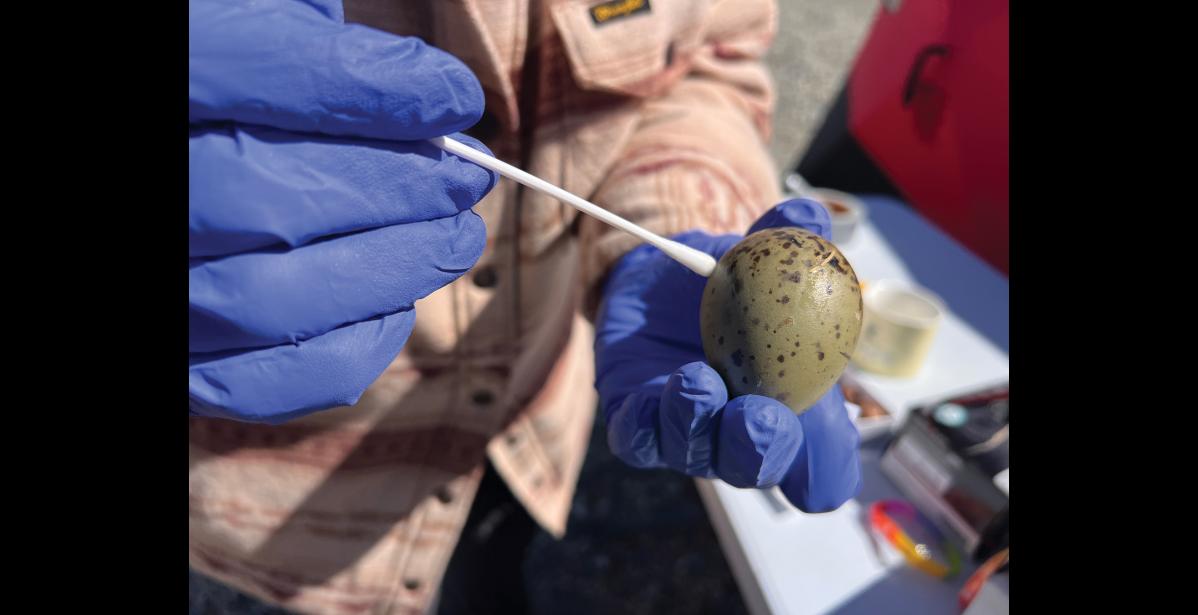
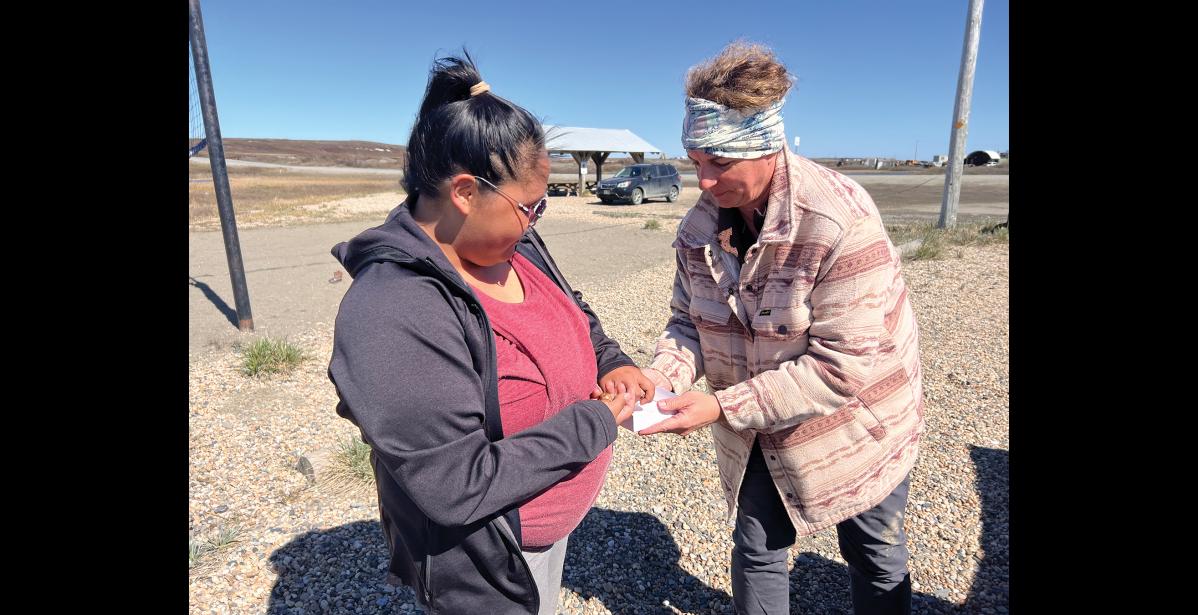
To fill gaps with sampling, Dr. Kercher spent the week in Nome, working out of the back of her rental car parked at East End Park. A woman came by, with a handful of snipe and gull eggs. Kercher obliged, bringing out the test kit and swabbing gently the eggs. “This is a first,” she said. “I’ve never tested eggs.” Usually, she takes samples by running the swabs in the bird’s throats and the rear end.
Kercher traveled from Memphis, Tennessee to Nome with her mobile lab including the instrumentation to run molecular test to see if the birds have HPAI. “This is sort of just like a pilot test run,” she said. “What I want to do is meet everybody here and just see what your issues are and listen to the community. Then we can go from there and maybe we can figure out a way forward that helps us do research and helps you guys get some information that you normally would not get.”
At home, she has a camper and drives her lab up and down the Mississippi flyway. She called the Pacific Flyway enormous and her visit to Nome was a first attempt to see if a collaboration with other entities would work and to find out what are the gaps are on the ground. “We are here to ask the scientific questions and learn how the disease is working in these birds,” she said.
She added that the bird flu that is circulating now has killed more wild birds than the highly pathogenic flu has ever killed in the past. This strain of bird flu spreads fast and kills birds within 48 hours. “This particular strain is pretty promiscuous,” she said. “It can go pretty quickly into lots of different species.” The strain is also affecting the birds or animals neurologically.
When in the past it was hard to detect bird flu in affected birds, now people see birds with bobbling heads, swimming in circles and being disoriented or lethargic.
The bird flu can be picked up by small terrestrial mammals, they die and their carcasses are scavenged by larger mammals, and then they will get the neurological disease. “So that’s the thing that’s changed, and that’s what’s motivating me and St. Jude and other researchers to get out here and do more surveillance and think about how the disease is working now, because it’s different than it was back in 2006 or 2007,” Kercher said.
The virus is transmitted by contact, but also the virus ends up on the ground, and it survives on even the cold ground of northern Alaska. Kercher said in the Lower 48, she tests the sediment as well but not much testing of the soil has been done here in Nome or the region.
The results of the testing done over the past week are pending.