
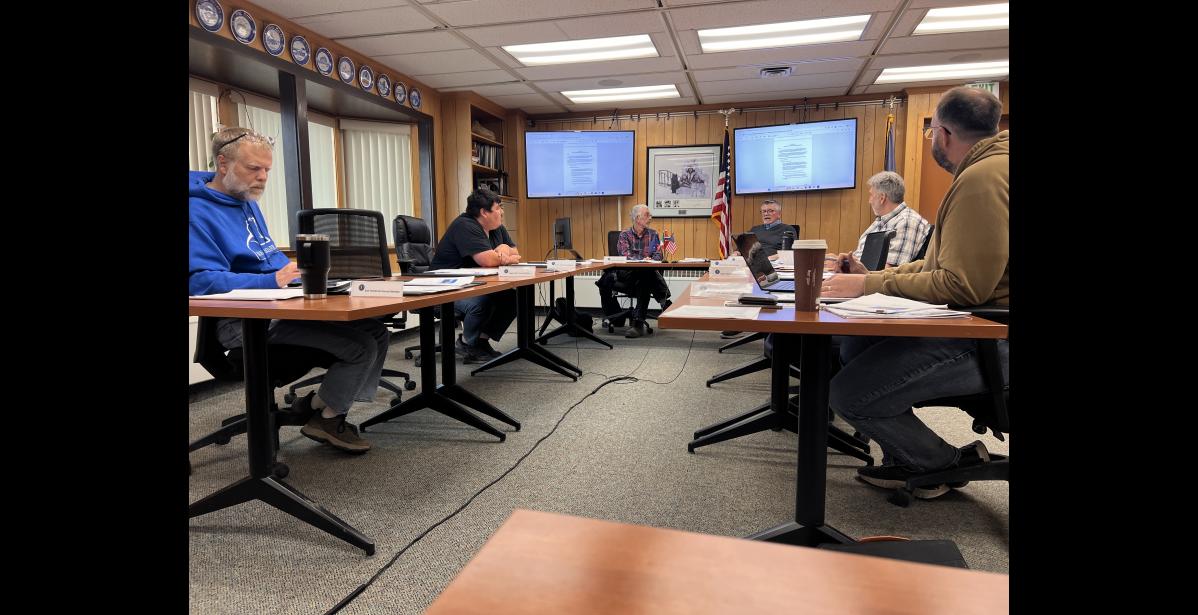
Common Council hears of Nome’s growing pains
Nome feels growing pains. For the lack of a long-term transportation plan, an outdated comprehensive plan and growing demands to address dust, potholes and housing needs, the city government is now trying to play catch up.
The Nome Common Council heard on Monday that a coalition of tribal, state and city governments plus private industry are tackling the dust issue. The city urges motorists to slow down to keep down the menace of dust as speed reduction in addition to watering the gravel roads seem to be the immediate steps that can be taken to deal with dusty roads.
City Manager Lee Smith reported that the city focuses on the message to slow down by putting up reduced speed signs which will be placed mostly on Greg Kruschek Avenue. In addition, the Nome Police Department, he said, would be enforcing the speed limits and starting to hand out tickets to speeding motorists.
Public Works Director Cole Cushman reported to the council that signs have arrived, warning motorists of “dusty conditions and reduced speed ahead.” The signs are 15 mph, 20 mph and 25 mph speed limits with temporary stands. “The plan is if we get in conditions where we have excessive dust, we will get them spread out on Greg Kruschek [Ave.] at both ends and in the middle near G or K [streets], and so we’re kind of catching traffic going in both directions and slowing it down to whatever is needed,” Cushman said.
Smith said that the city is in the process of organizing a Transportation Committee with Nome and regional entities to meet regularly to address concrete solutions for “growing pains” issues, such as pedestrian crossings on Bering Street and Greg Kruschek Avenue, electronic signage, road maintenance and a more vigorous involvement in the Alaska DOT’s Statewide Transportation Improvement Program, STIP for short.
Smith stressed that long term planning is needed to attract funding for transportation improvements that are long overdue.
“First thing we need in this city is a full-fledged transportation plan,” Smith told the council. “We don’t have one, and that’s got to be done with all these connections to the state, with the port, all the things happening there. We’ve got to look at five years, 10 years out,” he said, adding that is not sufficient to just look a year ahead in planning.
In public comments, the council heard from Ashley Miller-Earp and Billi Jean Miller-Earp, the proprietors of a new taxi service in town. They reported to the council that they appreciated the city’s assistance in getting their cab service legally up and running, but also said that Steven Longley, who still operates in a gray zone with his “rides for donations” is causing problems. “He’s been pretty vocal against us, and has even gone so far as to park his rented car outside of our house and watch us, call our cab company to discuss our decals that are have not arrived yet — we got an extension from the city — and overall, just give us a really hard time,” Ashley Miller-Earp said.
Nobody from Nome Joint Utilities was present to deliver a NJUS report. Council member Mark Johnson inquired about the lack of reports and asked again about progress on the years of audits that NJUS is behind on. How can the council compel answers from NJUS, he asked. “This has been going on for several years now. We can’t seem to get reports, either budgets or audit reports, and it’s negatively affecting the community as a whole,” Johnson said. “It’s negatively affecting the city on our audit reports. What can we do?” City Manager Smith recommended that the city’s attorney draft a formal letter to request answers based on ordinances, codes or standards that need to be adhered to as to the obligations from NJUS to the city. Council member Scot Henderson remembered that NJUS General Manager John Handeland provided the council not too long ago with a timeline on audit completion, and asked Smith to inquire as a starting point to ask for information. Council member Adam Lust was on board with the attorney’s letter. “I think at this point we’ve extended every courtesy we possibly could,” he said.
The Nome Common Council had no action items before them but discussed two separate contracts that involve spouses of city employees. Council member Mark Johnson stressed that the city ought to publicly disclose when a city employee, their spouse or children are hired or enter into a contract with the city. “Any time we’ve had an employee of the city or even children […] get hired by the city or do a contract with the city, we’ve had a public announcement,” Johnson said. “I think that’s a practice that we should continue to take back up again as we used to do.”
One of the contracts involved the lease of the newly renovated commercial kitchen at the Bowling Alley in the Rec Center. To foster economic development and use the facility to generate income, Smith floated the idea to rent out the kitchen to restaurant start-ups in Nome. The idea received the green light and after going through the process of advertising with a Request for Proposals, vetting the few responses and business plans, Smith extended a contract to Luz Valdez and her business “La Casita Taco Shop.” The lease only names Valdez, but the state’s business license also names her husband Jonathan Richard Fuentes, who is employed by the city as building inspector. Council member Johnson pointed this out and urged the city administration to disclose when contracts go to city-adjacent people. Smith defended his decision to offer the two-year lease to La Casita for a monthly rent of $2,000 plus utilities by saying that Valdez had the most compelling and complete business plan. The commercial lease agreement started July 1, 2026, and will expire in two years. Council member Scot Henderson said that he too has had concerns initially when the city leases or sells equipment, but he was satisfied that a fair and public process was used in choosing the restaurant start-up.
Luz Valdez and Fuentes went before the city council and thanked the city during public comments for the opportunity to lease the kitchen.
The other contract is a two-year contract between the city and Emily Stotts’ business Rural Alaska Animal Resources LLC, for animal services and animal shelter management in the amount of $5,000 per month. Duties include operating an on-call animal shelter, enforcing vaccination requirements, returning or rehoming impounded animals, maintaining records of all animals, providing emergency responses for injured or deceased animals, providing care and coordination for pets whose owners died or who were displaced by natural disaster.
Stotts is to provide her facilities to house the animals and must use her own vehicle to respond to calls. Stotts is married to Harbormaster Lucas Stotts, an employee of the Port of Nome, which is operating under the city of Nome’s umbrella. However, this contract was not subject to much discussion.
Emily Stotts has provided the services before. She went before the city council and expressed that she was “happy to be back officially in the capacity for animal services for the city.” She summarized her long involvement in animal services, saying that more than a decade ago now, Paws of Nome was established in response to two critical challenges in the community: the limited access to veterinary care and the need for consistent animal control services. “Over time, our programs have evolved to address the public health, public safety, and animal welfare issues that stem from those challenges. Addressing those same needs continues to guide my work today. I have accepted the responsibilities of city. Nome animal services contractor to address the city’s immediate animal care, animal control, and ordinance enforcement needs,” she said. She added that development will consist of animal-related ordinance review and updating, as well as creating a plan for adequate city facilities in the future. “My goal is to remain responsive to community needs and take the most responsible path forward in developing an animal services system that the people of Nome can rely on well into the future.”
The city also renewed its agreement with the Nome Chamber of Commerce to pay $160,000 per year for the Chamber to operate the Nome Convention and Visitor Center out of the city-owned building on Front Street. The city charges no rent for the building and pays for heat, utilities and upkeep. The Chamber is to staff and operate the Visitor Center.
Asked about city employee staffing, Smith reported that he is reworking the job description for the assistant city manager’s position, requiring more background on planning and is advertising the position at a nationwide city manager’s association platform. City clerk Dan Grimmer has left Nome and is until February under a remote contract with the city.
The Nome Police Department has three new officer hires to replace those who have quit. Sgt. Brandon Barry reported to the council that NPD tries to hire locals by offering dispatcher jobs to local prospects who may then transition to become officers.
A work session tackling an overhaul of taxation on pull tabs preceded the regular meeting and given the complexity of the issue, the council plans to meet on pull tabs again soon.
Finally, Mayor Kenny Hughes in his mayor comments gave a cryptic statement that alluded to his current predicament not connected to city business but to his day job.
Hughes operates a gold mine adjacent to the Nome-Council Highway near Swanberg Dredge. Hughes obtained a driveway permit to access the mine from the Alaska Dept. of Transportation. Sitnasuak Native Corporation disputes the validity of the permit and last week blocked the access to the mine with a Sitnasuak vehicle. Hughes, without providing this context, said during mayor’s comments that “there’s not really a whole lot I want to address about this week’s events in this particular setting,” but went on to say “it’s frustrating that elements of our community feel that taking physical steps for arguing legal issues is a terrible idea and so unnecessary.”
He then addressed the city administration. “It’s unfortunate that the city doesn’t feel empowered to maintain a safe access for all businesses […], but I understand the problematic situation that the city is faced with, not understanding the nature of some of the conflicts. I’m hoping that some of this can be resolved community-wide for all time through the process that ensues. And hopefully, when the community heals from it all, we’ll have a better place. But it’s going to be a tough road as we begin this.”
The next council meeting is planned for July 27.