
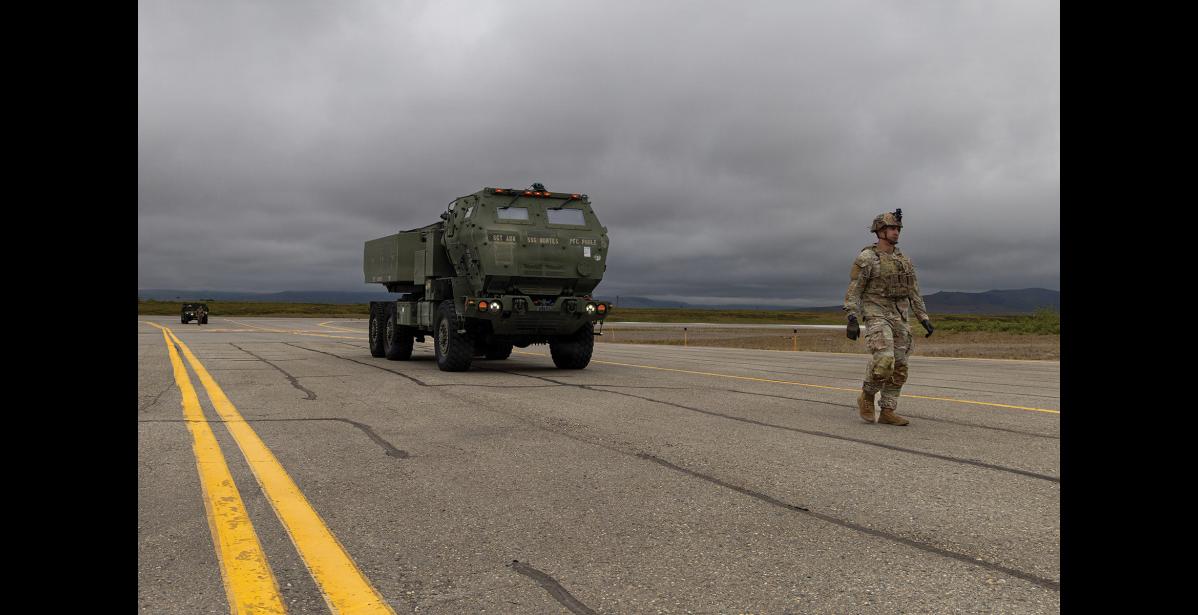
Tundra Merlin: Military conducts exercise in Nome
Big military aircraft, Apache helicopters and camouflage-colored military vehicles are sights Nome is not used to.
But for the first week in August, a joint Canadian and U.S. exercise dubbed “Tundra Merlin” is taking place in and around Nome, so be ready to see unfamiliar vehicles in and around town.
The activities were announced in press releases and social media posts last week by the public affairs office of Alaskan NORAD Region, Alaskan Command, 11th Air Force at Joint Base Elmendorf-Richardson.
Although no time frame was given, the mobilization appeared to have started on Friday, July 31. Soldiers are headquartered at the National Guard Armory, where military vehicles are also parked.
According to press releases the U.S. Army is rapidly mobilizing equipment and personnel in the vicinity of Nome “to demonstrate its ability to quickly position capabilities in remote Arctic environments.”
A press release alerted Nomeites that on Aug. 4 and Aug. 6 aircrews conduct planned training missions in the vicinity of Nome with low-flying military aircraft. “These flights are part of routine military movements and have been carefully coordinated to support operations,” the release said.
It is not clear if the stormy, rainy weather with high winds and low ceiling has impacted the training.
Several large military cargo planes and a Canadian Globemaster transported machinery and soldiers to Nome. U.S. Northern Command deployed an M142 High Mobility Artillery Rocket System, HIMARS for short, to Nome on July 31, another press release said.
“The 17th Field Artillery Brigade, I Corps, deployed the HIMARS from Joint Base Lewis-McChord, Washington, to Nome aboard a Royal Canadian Air Force C-17 Globemaster III. En route to Nome, the aircraft also stopped at Fort Wainwright, Alaska to transport Soldiers from the 1st Battalion, 5th Infantry Regiment, 1st Mobile Brigade Combat Team (Air Assault), 11th Airborne Division who are also participating in Operation TUNDRA MERLIN,” the release reads.
The deployment brings mobile, long-range precision fires to the Alaskan theater of operations and demonstrates U.S. and Canadian forces’ capabilities to rapidly move combat equipment and personnel across the Arctic in defense of the Homeland and its approaches, says the press release.
“This deployment under Operation TUNDRA MERLIN demonstrates our ability to rapidly deploy forces and seamlessly integrate joint capabilities across the Arctic,” said U.S. Army Maj. Gen. John Cogbill, 11th Airborne Division commander. “By deploying alongside the HIMARS, we are proving our readiness to deter adversaries by demonstrating lethal, long-range precision capabilities that can hold their assets at risk.”
The military released several photos of the HIMARS on top of Anvil Mountain, overlooking Nome.
This release was not only sent to Alaska media, but among the cc’d field of email recipients were several Russian media outlets.
In response to follow up questions about the operation, a spokesperson replied, “we are unable to provide further information regarding operational activities beyond what has already been released.”
Operations at sea
As part of operation Tundra Merlin, U.S. and Canadian maritime forces concluded a five-day, 800-mile combined sail through the Bering Sea and Bering Strait to strengthen Arctic security, Jul. 20-24. A press release from the Coast Guard said that the allied formation featured the U.S. Coast Guard Cutters Munro (WMSL 755), Storis (WAGB 21), and Fir (WLB 213) sailing alongside the Royal Canadian Navy vessel HMCS Max Bernays.
SOCNORTH
In addition, U.S Special Operations Command North, SOCNORTH for short, said in a social media post on June 24 that a SOCNORTH planning team traveled across Alaska visiting Utqiagvik, Point Hope, Savoonga, Gambell, Wales, and Little Diomede and that they have met with tribal and city councils, village ANC boards and North Slope Borough leaders. “During these meetings we formally requested permission to conduct upcoming training operations in these areas,” the post said. “We received approval and incredible hospitality across the board. Quyanaqpak, Igamsiqanaghhaalek, thank you very much, to the leaders and citizens of these communities for your unwavering support as we continue to strengthen our Arctic partnership.”
No dates were revealed when those training operations would take place.