
High fuel costs, midterm elections are front and center at AFN
As Alaska Natives from across the state attended last week’s Alaska Federation of Natives conference, two issues were at the forefront: the high cost of fuel and the urgency of voting.
This year’s convention was the 60th anniversary of the annual gathering. Attendees from all across the state packed into the Dena’ina Center in downtown Anchorage.
AFN President Ben Mallott said the convention is powerful and brings people together. “AFN is truly a gift from our founders and the generation before,” he said. “It’s something that’s truly remarkable for 60 years, and hopefully for another 60 years.”
In the plenary chamber, speakers from across the state and country gave talks. In other rooms, regions held their caucuses. In the halls, friends and family from across the state greeted each other after a year apart.
Quyana Nights and Craft Fair
On the bottom floor, hundreds of vendors stocked stalls with artwork, jewelry, food, clothing and other goods. Dennis Pungowiyi and his son Ronnie sold many of their ivory carvings on day one of the convention to collectors.
Mary Jane Litchard of Nome brought binders full of prints of her artwork. John Waghiyi, Jr. of Savoonga sold carvings and ivory rings.
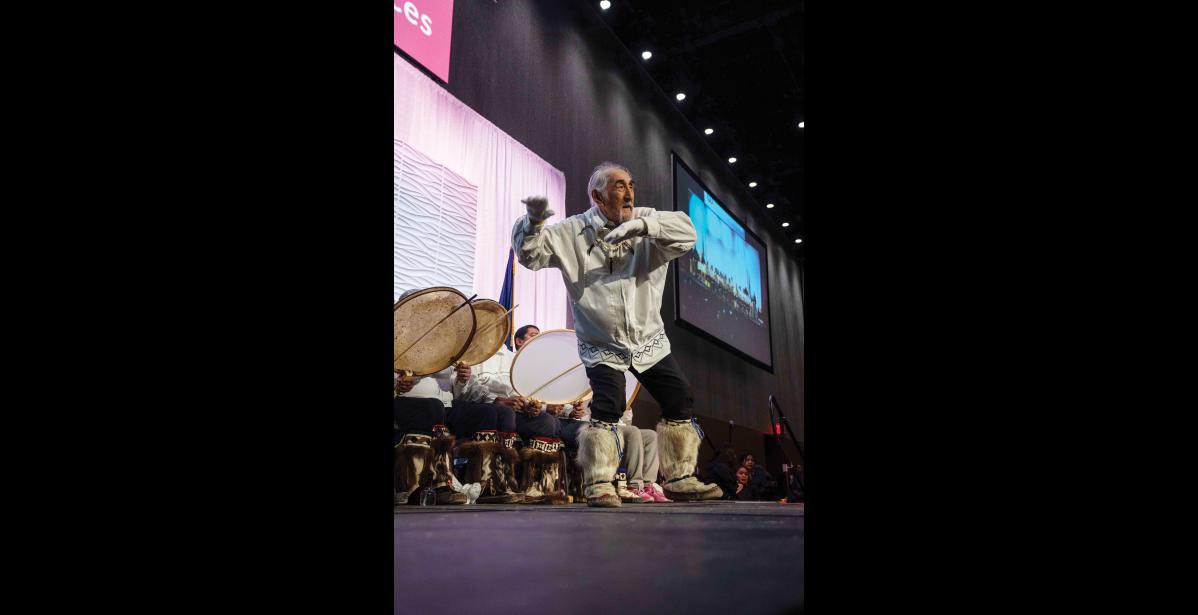
In the evenings, there was barely room to walk as people packed into the hall for two sold-out Quyana Night performances.
Dancers crowded the front of the room and walkways during invitationals. On Friday, a great cheer went up for the Tikigaq Traditional Dancers boxing dance, and the group performed it twice in a row.
Fuel prices
During Senator Lisa Murkowski’s speech on Thursday, she addressed the rising costs of energy and fuel. “It is wrong. It is wrong that fuel prices are so high,” she said to applause. “For six months now, I have voted to responsibly end the war in Iran.”
Murkowski promised to look for permanent solutions to the high prices, acknowledging that solutions are going to look different depending on which community they are implemented in.
The senator also addressed proposed barriers to voting, saying that while in the past she’s supported requiring an ID to vote, she does not support the SAVE Act. “We need less confusion. We need fewer obstacles to voting,” she said, “So for me, saving America starts with preserving your right to vote.”
Keynote
Keynote speaker Rosita Worl, the president of Sealaska Heritage Institute, also spoke on the rising cost of fuel. “Can you imagine our families having to make a decision between two basic needs: feeding their family or keeping them warm?” She asked the audience.
Worl also talked about the formation of ANCSA, and talked about how the leaders at the time recognized that the act had “flaws and dangers” that conflicted with cultural values. She gave an overview of the 1988 ANCSA amendments, which limited the sale of stock in Native corporations in perpetuity, expanded shareholder eligibility and extended the exemption of Alaska Native corporations from some federal securities laws.
Worl and called on today’s generations to step forward. “I believe we have come to another juncture in our history in which we must unite, as our historic leadership did, to address two major threats to our cultural survival: subsistence and the vitality and survival of our rural communities,” she said.
Worl listed numerous positions supported by AFN, including supporting Alaska Native Aboriginal hunting and fishing rights, amending the subsistence priority in the Alaska National Interest Lands Conservation Act, or ANILCA, to provide a subsistence priority to all Alaska Natives and rural residents, the co-management of fish and wildlife resources and amending the different definitions of Alaska Natives in ANCSA, ANILCA and the Marine Mammal Protection Act to create a single definition of Alaska Native without the federal blood quantum.
“We know what needs to be done, but we have yet to advance these measures to Alaska’s congressional delegation and Alaska’s governor and legislators,” she said. “It is this generation of leaders and AFN who must develop and implement strategies to accomplish the proposed resolutions to ANCSA, ANILCA, the state constitution and fish and wildlife management.”
Get out the vote
AFN President Ben Mallott told the audience that the best way to support AFN’s projects and policies was to vote. Which gubernatorial candidate wins the election determines who picks members of the board of game and board of fish. “You’re looking for multiple organizations and multiple management procedures that would that impact our life,” he said. “So thinking about that, where you vote really makes it matter.”
“Alaska Natives make up 20 percent of our population. With that, we have a very strong voice. Our voice is only amplified if we vote,” he said. “When we don’t vote, we weaken our community organization, weaken our boat.”
In an interview , Mallott said that Get Out the Native Vote partnered with a variety of non-native organizations to work with.
Voting, he said, is “critical” for the Native community.
BIA
Billy Kirkland, the Assistant Secretary for Indian Affairs with the Department of the Interior, spoke on Thursday to attendees, expressing that the Bureau of Indian Affairs needs the help of everyone in the Native community. “Specifically, we’re in the process of hiring 400 plus new employees, and if you have individuals that want to work at the BIA, or if you see gaps in services, let us know what those are because we want to fill those gaps,” he said. “We want to work with y’all to do that. We want to come away from kind of being an agency of ‘no’ and work with you to get to ‘yes.’”
He finished his speech by calling Senator Murkowski and Bureau of Land Management Alaska State Director Kevin Pendergast on stage and signing off on three allotments for Vietnam-era Native veterans who were absent when allotments were initially allocated.
Rules changes
Craig Jacobson with law firm Hobbs Straus Dean & Walker, gave a presentation on proposed changes in the federal Office of Management and Budget, or OMB, that would give the office more centralized authority of funds. The proposed rule would allow OMB to make a priority list of who can qualify for specific grants and allow the office to add conditions. “It’s going to add a bunch of different layers of responsibility for small tribal governments,” he said. “If there are subawards, like through a consortium, that then go down to tribal governments. Those would have to go through additional approvals.”
Finally, OMB would have more power to suspend or terminate a grant even while the grant is running. The rule is currently frozen until December 11, when the current continuing resolution funding government expires. The Trump administration has not committed to tribal consultation on the rule as of yet, so Jacobson urged attendees to be in contact with the Congressional delegation and plan for ways to minimize risk to tribal governments. “The way that the proposed rule is written, it would make it far more complicated, especially for small tribal governments to administer federal funds,” he said.
Military
Lieutenant General Robert Davis, the commander of Alaskan NORAD said Alaska represents a strategic military presence in the Arctic. He referenced Operation Tundra Merlin, a military training exercise that took place this summer near Nome, as well as Operation Polar Dagger, which also took place in the Bering Strait region. He said when the military operates in Alaska, they have to do so while communicating with local communities. “That means understanding possible effects on subsistence hunting, fishing, access to land, travel, and daily life,” he said. “It means respecting tribal sovereignty and local customs, minimizing disruptions where we can, and keeping the lines of communication open throughout the entire operation.”
Davis said the military is committed to keep lines of communication open and wants to hear from local communities. “These conversations make us better at what we do,” he said. “They give us better understanding of the communities and local considerations that matter most to you, and the ways that military activity may affect your daily life.”
Resolutions
Roy Agloinga, President and CEO of the First Alaskans Institute, said in an interview with the Nugget that at this year’s Elders and Youth Conference, the main concern was the high cost of heating fuel and gas. From the conversations and topics that arise at the Elders and Youth conference, resolutions can be introduced for consideration at the following year’s AFN.
On the final day of the convention, Saturday, October 24, AFN delegates came together to vote on resolutions concerning health, safety, welfare, subsistence, education, land and resources, transportation, ANCSA, tribal rights and more. Forty-nine resolutions were passed; one resolution, which concerns tribal authority to protect land and waters from hard rock mining, was passed onto the Board Legislative and Litigation Committee.
Kawerak submitted three resolutions. One calls for a statewide “feather alert” model when a Native person is missing, similar to an Amber Alert. Melanie Bahnke, President and CEO of Kawerak, said that resolution would allow for communities to be alerted in real time when someone goes missing. “There are a number of people that would, go looking for somebody if they’re missing,” she pointed out.
Another resolution calls for the strengthening of energy security and resilience in rural communities. “People are actually having to choose between putting food on their tables or heating their homes,” Bahnke said. “We’re really concerned about the long-term ability for our villages to be sustained when we can’t even heat our homes.”
A third resolution, submitted alongside Sealaska and the Central Council of the Tlingit & Haida Indian Tribes of Alaska, calls for a moratorium on seabed mining to protect subsistence, natural resources and tribal sovereignty.
Kawerak supported the final resolution because of the as-of-yet unknown effects of deep-sea mining. “Our ocean is our bread basket. So many of our communities rely on the ocean to sustain us and feed us,” said Bahnke. “Until there’s some kind of an environmental impact study, we feel like it’s really unwise to just open up places.”
AFN also passed two resolutions that were introduced on the floor. The first calls for Congress to withdraw or reverse provisions of the Bipartisan American Affordability and Jobs Act, which would weaken consultation requirements and the role of Tribal Historic Preservation Offices in section 106 of the National Historic Preservation Act. The second resolution opposes changes to the 2030 census that would alter the definition of “usual residence” and remove race and ethnicity questions, including the ability to identify Alaska Natives and American Indians in census data.
The resolutions were introduced late, not because of late paperwork, but because the issues they concerned arose after the resolution deadline. Both resolutions were submitted on behalf of the Southeast caucus.
In a somewhat unusual move, the convention chose to move into an executive session when considering the resolutions. Mallott said the decision was a practical one. AFN is free and open to the public and media by design, but that means that discussions happen in front of everyone. “There are times, though, because this is our annual meeting of our membership, that we do need to have those sessions,” he said. “That’s just a normal governance feature of operating, and when you have a statewide audience, sometimes you might not be as free to say stuff.”
As an early sunset began to creep over the Chugach mountains, Dena’ina Center employees began to clear away chairs in preparation for that evening’s banquet. The vendors downstairs packed up their wares and folded up their tables, and attendees spread throughout the city, packing to go home.